
Communities Are the Front Line
Dec 03, 2025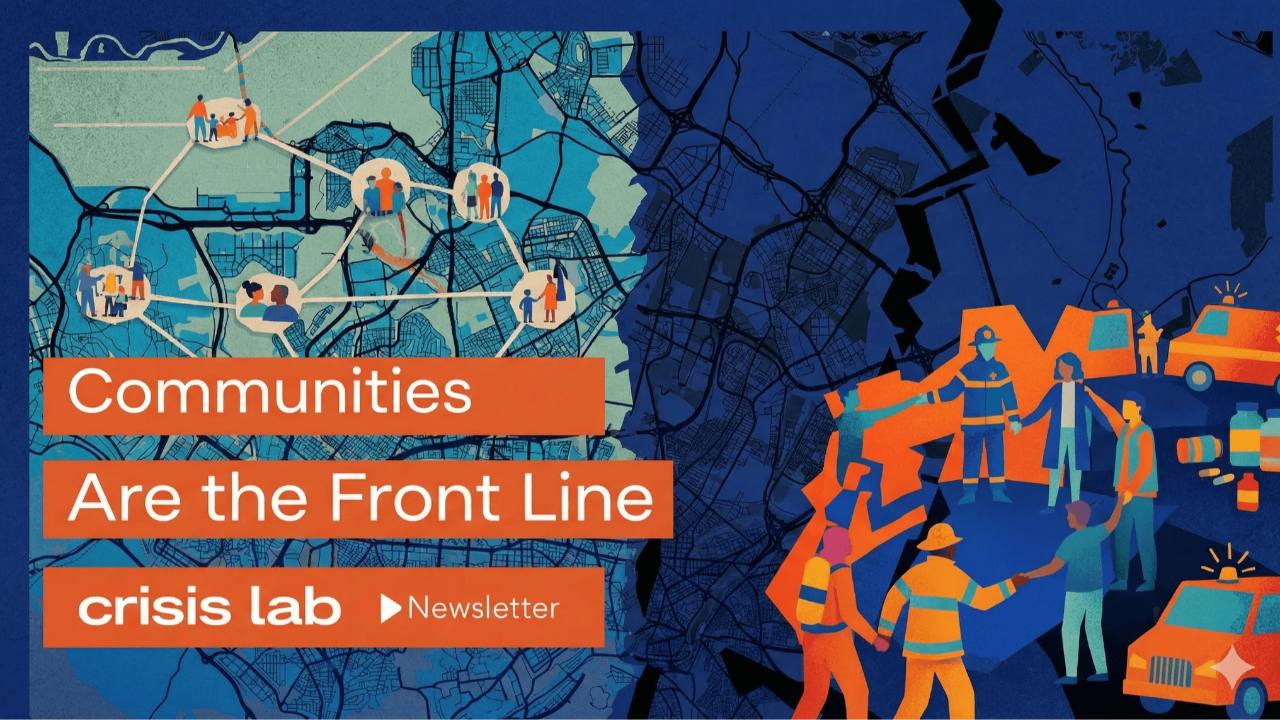
This Thanksgiving, there’s a lot on my mind.
Not just the usual reflections on gratitude and family, though those matter. Something deeper. After a year of working alongside crisis professionals across 40 countries, watching how communities respond when systems fail, one truth keeps surfacing: everything that matters is local.
We say it constantly in this field: all disasters are local. But this year, I’ve come to see it differently. All conflict is local too. All survivability is local. When the infrastructure fails, when coordination breaks down, when the plans don’t survive contact with reality, what remains is the community. The neighbors. The first responders. The people who show up because showing up is what they do.
And that realization has me thinking differently about gratitude this year.
The shift no one predicted
The past year brought a quiet realization across the crisis management field. As threats have become more complex and interconnected, the response models built for centralized coordination have shown their limits. Cyber attacks cascade into infrastructure failures. Climate events overwhelm regional capacity. Disinformation erodes trust in institutions at precisely the moment communities need to act together.
And yet, we always seem to be caught off guard.
In every after-action review, the same pattern emerges: the communities that survived weren’t necessarily the ones with the most resources. They were the ones with the strongest local networks, the clearest lines of mutual support, the neighbors who knew each other’s names.
This shouldn’t be surprising (though somehow it always is). Governments can coordinate. International organizations can provide resources. But when the power goes out and the roads are impassable, it’s the person next door who shows up first.
Why this matters now
The crisis management profession has spent decades building systems optimized for scalability. National frameworks. International protocols. Multi-agency coordination centers. These matter. They enable response at a scope no single community could manage.
But somewhere in the pursuit of coordination, the field forgot a fundamental truth: resilience doesn’t scale down from institutions. It scales up from communities.
A neighborhood that knows how to organize itself doesn’t need to wait for external direction. A town with strong volunteer networks can absorb shocks that would paralyze communities dependent entirely on outside support. First responders matter precisely because they’re local, because they understand the specific geography, the particular vulnerabilities, the actual people who need help.
The professionals staffing ambulances, fire stations, and emergency management offices tonight didn’t take the day off because it’s a holiday. They understand something the rest of us often forget: emergencies don’t respect calendars. And when those emergencies arrive, the first line of defense is always local.
The real meaning of gratitude
Thanksgiving, for all its complicated history, carries a simple truth at its center. Survival has always depended on others. The early settlers who celebrated that first harvest understood something many modern institutions have forgotten: no individual, no family, no organization succeeds in isolation.
Communities are not just nice to have. They are the infrastructure of survival itself.
The professionals who spend this holiday on call, the volunteers who staff warming centers, the neighbors who check on elderly residents when temperatures drop, the emergency managers monitoring weather patterns instead of watching football with their families: these aren’t peripheral contributions. They are the foundation everything else rests on.
When crisis strikes, the federal response takes 72 hours minimum to mobilize. State resources need time to coordinate. But the neighbor with a generator, the local fire department, the community organization that has already mapped who needs help: they’re measured in minutes.
What the future demands
The world is changing in ways that make local resilience more important, not less. Climate disruption means more frequent and severe local impacts. Digital interconnection means local cyber incidents can cascade globally. Geopolitical instability means communities may need to function when national systems are compromised or overwhelmed.
None of this diminishes the importance of coordination at scale. But it fundamentally reframes where resilience actually originates.
The communities that will thrive in the coming decades won’t be the ones waiting for someone else to save them. They’ll be the ones investing now in local capacity, local networks, local expertise. They’ll be the ones who understand that when the systems fail (and systems always fail eventually), what remains is each other.
A different kind of thanks
So this Thanksgiving, I’m thinking about a different kind of gratitude.
Not just for family gathered around tables, though that matters. Not just for abundance, though that matters too.
I’m thankful for the first responders who didn’t get to gather today. The emergency managers reviewing contingency plans while others watch parades. The volunteer organizations preparing for the next winter storm. The neighbors who will check on someone living alone, not because anyone asked them to, but because that’s what communities do.
These aren’t heroes in the dramatic sense. They’re something more important: they’re the everyday infrastructure of community itself, doing the quiet work that makes survival possible when everything else fails.
The world is changing. Threats are evolving. Systems will be tested in ways previous generations never imagined.
But the fundamental truth hasn’t changed at all: communities are first. Communities are longevity. Everything else is built on that foundation, or it’s built on sand.